
Épi leather: Louis Vuitton's understated signature
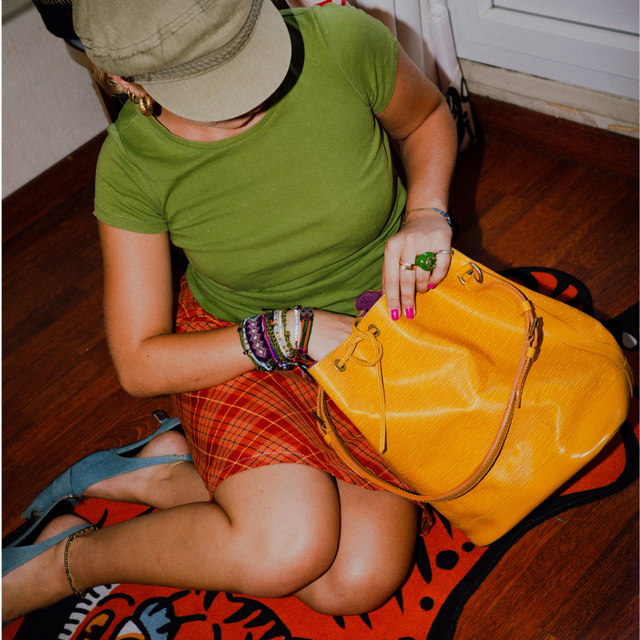
It does not announce its name. Where the monogram makes a statement, Épi leather whispers. Born from a wheat field beneath the sun, this embossed leather may be Louis Vuitton's most elegant expression of restraint and one of the most sought-after materials on the second-hand market.
Origins: a wheat field beneath the sun
The story begins in 1920, in the imagination of Georges Vuitton and his son Gaston-Louis. Father and son sought to capture, in a newly resilient material, the movement of a wheat field rippling in the wind. From this image came a pattern embossed in fine parallel waves, a design the Maison would name Épi, after the French word for a wheat ear.
The leather first appeared in the 1920s, notably on a tea case created in 1926 for a maharajah. At the time, it was mainly used for special orders and made-to-measure pieces, in the tradition of great travel objects. It was not until 1985 that Épi leather became a full-fledged line: the Maison's first collection of leather bags, based on the technique inherited from the trunks of the 1920s but modernised to be even more resistant.
Since then, Épi has continually reinvented itself. In 2014, when Nicolas Ghesquière became artistic director, he gave the material a contemporary new energy: his first collection placed it in the spotlight, beginning with the Petite Malle, somewhere between a minaudière and a treasure chest.

A signature recognisable at a glance
What sets Épi leather apart is its precise craftsmanship. The high-quality cowhide is embossed with the raised pattern and then dyed through. This dyeing process, carried out in successive baths, creates a subtle difference in tone between the deeper layer and the surface. The result is the slight two-tone effect that catches the light and gives the leather its depth.
The result is a material that is both refined and remarkably strong:
- Resistant to water and scratches, thanks to its textured surface and treatment.
- Made to last, with a patina that grows more refined over the years.
- Available in a wide range of colours, from timeless black to vivid shades of red, purple, green and pink that have made the material famous.
But Épi's most subtle strength lies elsewhere: its discretion. No showy pattern, only a small LV stamp in one corner. A piece in Épi leather is recognised only by a trained eye, making it, for many, the ultimate expression of refinement: luxury that knows itself rather than luxury that needs to be seen.
Caring for Épi leather
Hard-wearing does not mean indestructible. A few good habits are enough to keep an Épi piece beautiful for decades:
- Keep it away from greasy substances: moisturising cream, hand sanitiser and perfume. Bright or light-coloured models are particularly sensitive to them.
- Avoid moisture, direct heat and full sun; keep it away from radiators and overheated car interiors.
- Beware of colour transfer: prolonged contact with a fabric that bleeds can mark light-coloured leather.
- If it gets dirty, gently wipe it with a soft, light-coloured cloth. Never use soap or solvents.
- When not in use, store the piece in its original felt protective cover, away from light.